New CFIT Recommendation published: Referencing ISO 14024 Ecolabels in procurement
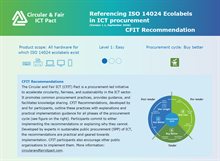
Participants of the Circular and Fair ICT (CFIT) Pact are pleased to present their second recommendation, ‘Referencing ISO 14024 Ecolabels* in ICT procurement’. The recommendation explains the benefits of referencing ecolabels in procurement and gives examples of how CFIT participants have incorporated ecolabels in their tenders. Classified as “Easy” this recommendation is, in the experience of CFIT participants, a no-brainer that can be adopted by any procuring organisation, particularly when procuring those product categories for which certified products are sufficiently available.
CFIT Participants recommend to: Make use of ecolabels according to ISO 14024 in tenders to select products within ICT product categories that are preferable from a sustainability perspective.
Johan Rodenhuis, Strategic Sustainability Advisor for the Dutch Central Government explains: “ISO 14024 ecolabels help us translate sustainability ambitions into credible and verifiable ICT procurement requirements. In our tenders, they provide independent evidence across a broad range of sustainability topics, including energy efficiency, product lifetime, repairability, circular material use, chemicals, hazardous substances and social responsibility in the supply chain. By referencing robust ecolabel criteria, we can raise ambitions at scale, reduce the administrative burden for suppliers and contracting authorities and use public procurement to accelerate the transition towards more circular, responsible and low carbon ICT.”
This recommendation applies to all product categories for which such ecolabel criteria sets exist. For product categories in which certified products are sufficiently available, referencing ecolabels in tenders is a straightforward and effective approach. If this is not yet the case, procurers can take measures to stimulate market development. The Recommendation also explains that there are different ways in which ecolabels can be used in procurement and the Annex of the Recommendation provides practical examples from CFIT Participants.
Several ISO 14024 ecolabels are available for ICT products. In the experience of CFIT Participants, the most relevant ones in our markets are, in alphabetical order, Blue Angel, EPEAT 2.0 and TCO Certified.**

How do ISO 14024 ecolabels help us translate sustainability ambitions into credible requirements?
A spokesperson for the Blue Angel ecolabel explains: “As an ecolabel according to ISO 14024, our approach is strictly grounded in a life cycle perspective, taking into account sustainability impacts from raw material extraction and manufacturing to use, disposal, and recycling. This comprehensive approach ensures that different environmental impacts are systematically addressed, effectively preventing the shift of environmental burdens from one life cycle stage to another, but also setting the correct focus per product group. For the Blue Angel Ecolabel, criteria are developed by the German Environment Agency, discussed with a wide range of stakeholders and approved by the Blue Angel Jury.”
The above explanation outlines critical elements that all ISO 14024 ecolabels comply with: they are third-party verified environmental certifications that are awarded to products or services that meet strict lifecycle-based sustainability criteria.
Kaushik Ramakrishnan, VP Global Market Development & Strategy from the Global Electronics Council, steward of the EPEAT Ecolabel, confirms “ISO 14024 ecolabels have done the heavy lifting by defining criteria across multiple impact areas and by independently verifying that electronics products meet those criteria. The registry or product finder of these ecolabels are a single source of truth for finding such products. The EPEAT registry, for example, provides advanced features to search for products that can help a purchasers meet their sustainable procurement goals.” CFIT Participants confirm that the online databases of the ecolabels facilitate market research prior to a tender as well as contract management. Please find links to the ecolabels and product in the recommendation.
You may wonder how this recommendation feeds into CFIT’s objective of accelerating circularity, fairness, and sustainability in the ICT sector? Clare Hobby, TCO Development's Global Director Purchaser Engagement, shares with us: “When purchasing organizations use a good ecolabel, they're not only making more sustainable choices, but adding their voice to a clear and coordinated signal to the industry, and thereby enabling faster progress toward sustainability targets. Our ongoing criteria development, and long term sustainability roadmap support continuous improvement in the ICT sector. The purchaser voice is an essential driver of these ongoing sustainability impacts.”
Marieke Weerdesteijn, Programme Manager of the CFIT Pact invites all procuring organizations to use this easy-to-implement recommendation. Do you have questions or would you like to join our procurement-led initiative and join hands with CFIT participants accelearate circularity, fairness and sustainability in the ICT sector? Contact us!
*Please note that since June 2026 ISO Standard 14024 no longer uses the term Type 1 Ecolabels, which is why in this news article and in the CFIT Recommendation, this term is also no longer used, while we are referring to ecolabels that comply with the same characteristics as those formerly known as Type 1 ecolabels.
** Note that in addition to the ISO 14024 ecolabels specifically mentioned in this document there may be other ecolabels that are available in different markets for ICT products. Ecolabels in the ‘full member’ category of the Global Ecolabelling Network (GEN) are ecolabels in accordance with the ISO 14024 Standard.
Download the CFIT Recommendation on Referencing ISO 14024 Ecolabels