Chemicals of Concern: where Circular, Fair and Climate Impacts meet
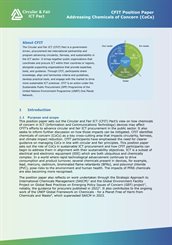
CFIT publishes its first Position Paper on Chemicals of Concern in ICT
An ICT product may be designed to last longer, be repaired and eventually recycled. Yet the chemicals it contains, or that are used in its production, can determine how safely those ambitions can be realised. Chemicals of concern can affect workers and communities, create environmental risks and restrict opportunities for reuse, refurbishment and material recovery.
This is why chemicals have been part of the CFIT Framework for Circular and Fair ICT Procurement from the outset. They form one of CFIT’s four central ambitions, alongside circularity, fair, and climate and energy. CFIT’s first Position Paper, Addressing Chemicals of Concern (CoCs), looks more closely at this area and identifies CoCs as a cross-cutting issue affecting circularity, fairness and climate impact reduction.
Developed by the CFIT Secretariat together with CFIT participants, the Position Paper sets out CFIT’s position on the role of chemicals of concern in circular and fair ICT procurement and how these impacts can be addressed through procurement.
More than restricting substances
ICT is chemically complex. Devices contain many different materials and components, while chemicals are also used during manufacturing and assembly. There is no single official regulatory list of chemicals of concern organised by ICT product type, and information on chemical composition can be difficult to obtain consistently across supply chains.
The issue therefore goes beyond restricting individual substances. The paper highlights the risk of regrettable substitution, where one hazardous substance is replaced by an alternative that may later prove to have similar or worse health or environmental impacts. Safer substitution, transparency and chemicals management across the product lifecycle are therefore important parts of the approach.
Procurement offers several points of influence. Before a tender, market analysis, risk assessment and supplier engagement can help organisations understand risks and what the market can offer. During the tender, relevant criteria and standardised disclosures can bring chemical considerations into purchasing decisions. After award, monitoring and contract management provide opportunities to follow performance and support improvement over time.
This is where CFIT has a particular role. Chemicals of concern sit at the intersection of technical expertise, supply-chain knowledge and procurement practice. CFIT brings those perspectives together. As a government-driven, procurement-led international partnership, it connects public organisations, CFIT participants with expert supporting organisations that contribute expertise, tools and guidance. Participants share knowledge, work towards greater alignment of criteria and guidance, develop practical tools and engage with the ICT market. CFIT is an action under the Sustainable Public Procurement Programme of UNEP’s One Planet Network.
From shared position to shared practice
The Position Paper sets out CFIT’s current position on chemicals of concern in ICT procurement and creates a basis for developing the work further. The next step is to combine procurement experience with specialist expertise, learn from practical cases and identify where guidance and criteria can become clearer and more consistent. It also provides a basis for exploring where procurement approaches can be better aligned or harmonised across organisations, reducing fragmentation and giving the market more coherent signals.
CFIT will continue this work with participants and experts that are already active on the topic or see opportunities to contribute practical experience. The current paper focuses on ICT devices. As CFIT’s scope also includes sustainable digital infrastructure, chemicals of concern within that broader scope offer a further area for exploration.
This Position Paper gives organisations a common point of reference for moving the issue forward: from understanding the risks to strengthening procurement practice, aligning approaches where possible and building the next steps together.
Read the CFIT Position Paper, Addressing Chemicals of Concern (CoCs), in the box on the right, and get in touch if your organization is interested in joining CFIT and contributing to this work.
CFIT Position Paper – Addressing Chemicals of Concern (CoCs)